IFRS 17 CSM engine for VFA and GMM
Group your contracts, measure fulfilment cashflows and a cost-of-capital risk adjustment, and roll the contractual service margin forward from opening to closing, with the loss component, reinsurance held, transition and the disclosure tables. Every figure checkable in Excel.
The CSM, from opening to closing
- Opening position by group: the CSM, the loss component and, for GMM groups, the locked-in rate.
- New contracts measured at their date of recognition: CSM or loss component.
- Interest at the locked-in rate (GMM) or the opening rate (VFA), for the period.
- Systematic allocation to the loss component (IFRS 17 50(a) and 52).
- Changes relating to future service: assumption changes, experience and, under the VFA, the change in the entity's share of the underlying items.
- Release by coverage units, and the closing CSM and loss component.
Each step is written up in the methodology note and rebuilt in the reviewer workbook.
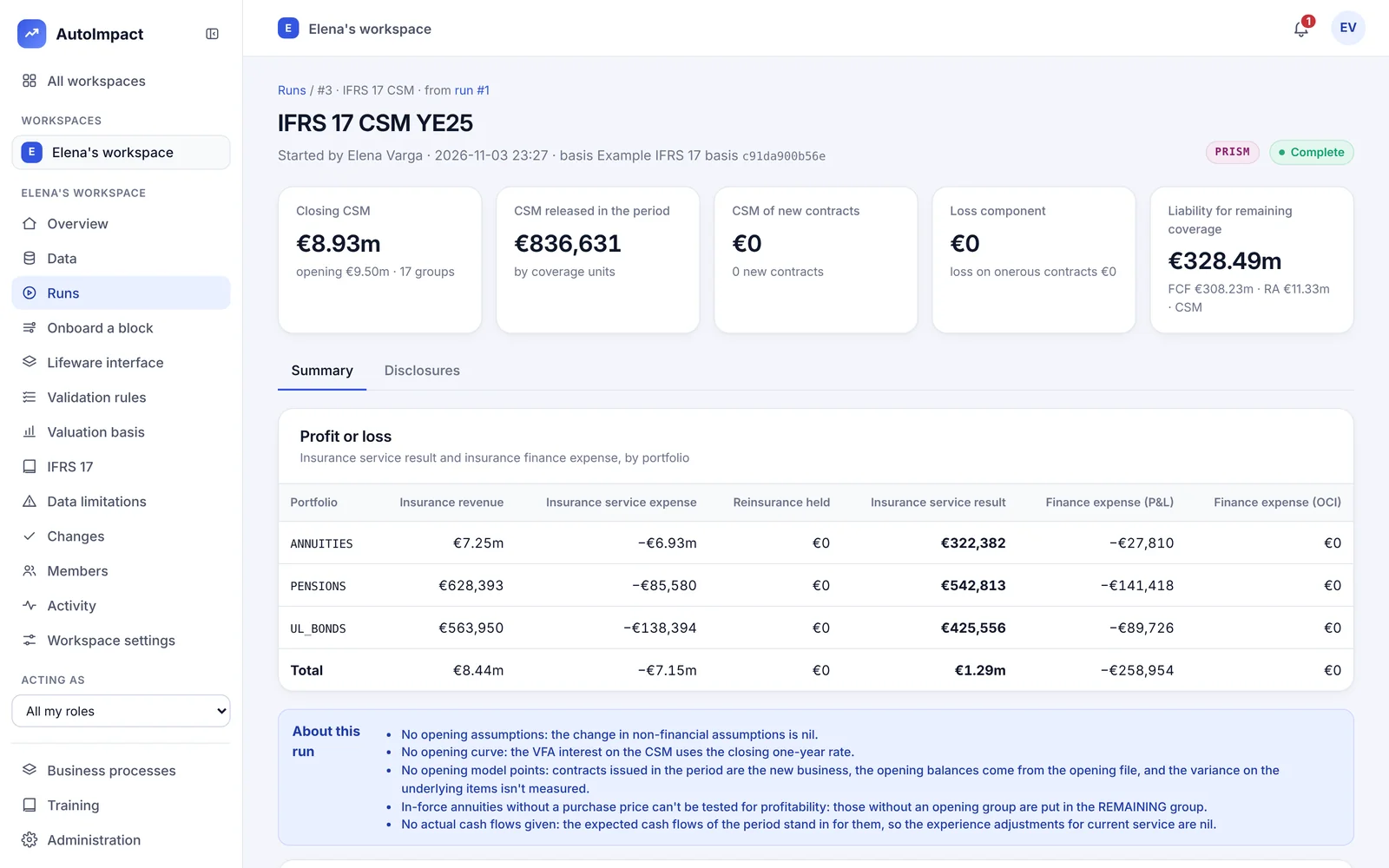
See it run
Basis, opening CSM, run, disclosures
Load the IFRS 17 basis and last period's CSM, run the roll-forward from a model run, and open the disclosure tables.
Works with your other systems
Use results from the systems you already have
The CSM engine doesn't need everything to come from AutoImpact. It takes the figures your other systems already produce.
Opening position
Last period's CSM, loss component and locked-in rate by group, from whichever system reported them, loaded as a CSV.
Actual cash flows
The period's premiums, claims, expenses and investment components by group, from your finance or policy systems.
Results out
Every table downloads as CSV, and model points export to Prophet format, so results flow on to your ledger and other models.
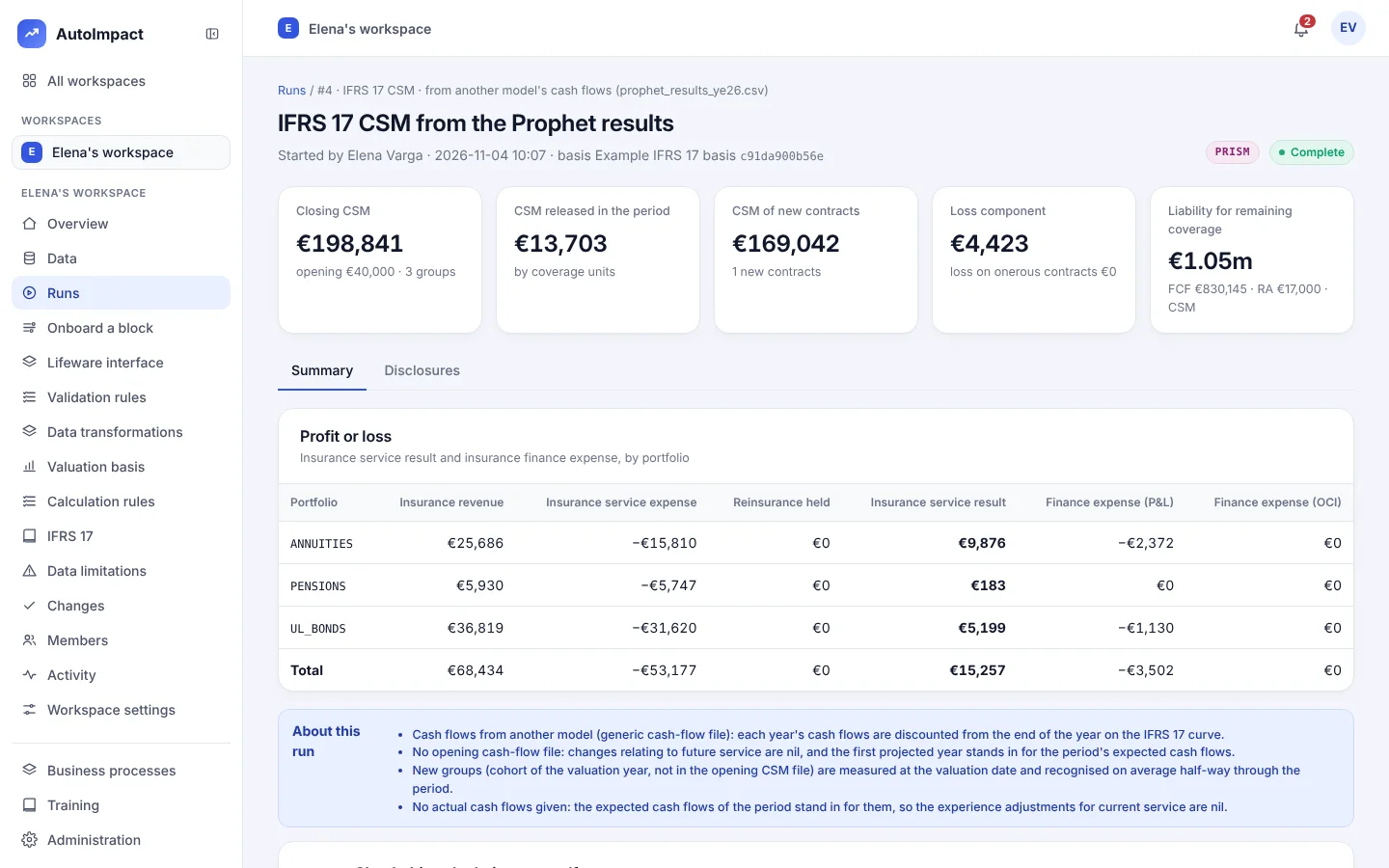
Another model's cash flows
One CSV, one row per group and year, from Prophet, AXIS, an in-house model or a spreadsheet, through the same CSM roll-forward, disclosures and reviewer workbook. How it works
New Run on another model's cash flows
The same CSM engine on your model's results
- One CSV. One row per group and year: group, year, premiums, claims, expenses, investment components and coverage units.
- Discounted for you. From the end of each year, on the chosen curve plus the basis's illiquidity premium.
- Same outputs. The CSM roll-forward, the loss component, disclosures 100, 101, 107 and 109, profit or loss and the reviewer workbook.
- Refused if wrong. A file with a mistake is refused with a reason before any run starts.
What the engine covers
Grouping (IFRS 17 14-24)
Portfolio, annual cohort and profitability at initial recognition. Contracts stay in their group from one period to the next.
Fulfilment cashflows
The projection made market-consistent on the risk-free curve plus an illiquidity premium; GMM changes at locked-in rates.
Risk adjustment
Cost of capital on mortality, longevity, lapse and expense stresses, aggregated with a correlation matrix and run off with the outgo.
Revenue and expenses
Insurance revenue excluding investment components, insurance service expense with incurred claims, and finance expense with an OCI option for GMM.
Reinsurance held
Quota share measured with the GMM: net cost or gain in the CSM and the loss-recovery component (IFRS 17 66A).
Transition
Full retrospective, modified retrospective or fair value approach per group, proposed as the opening CSM for approval.
Disclosures, ready to use
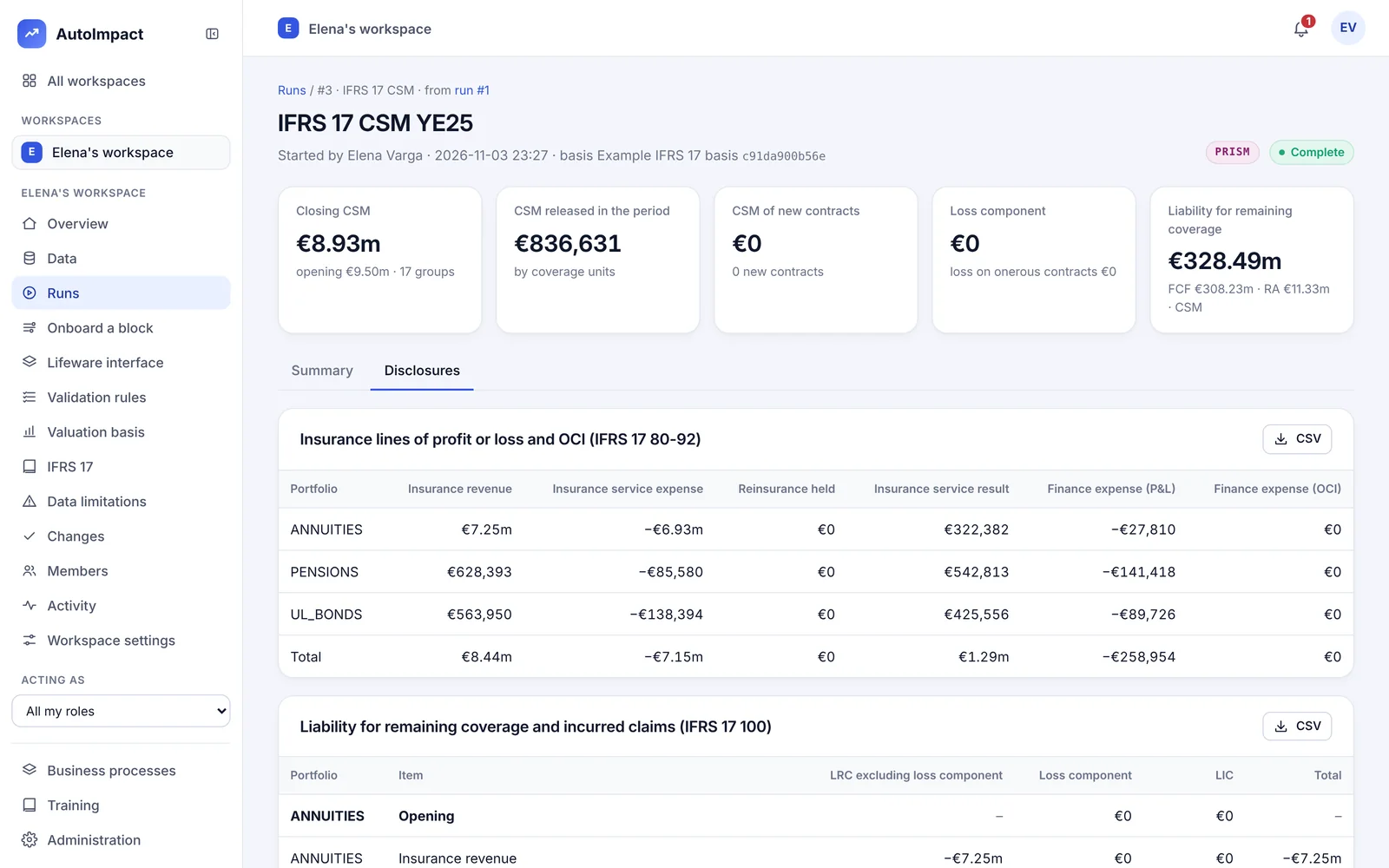
- Paragraph 100: liability for remaining coverage, loss component and incurred claims.
- Paragraph 101: PV of future cash flows, risk adjustment and CSM.
- Paragraphs 107 and 109: new business, and when the CSM will be recognised.
- Paragraph 119: the risk adjustment's equivalent confidence level (estimated).
- Each reconciliation shows any unexplained difference openly, as an "other changes" row.
Questions about the IFRS 17 engine
Does the CSM engine support both the VFA and the GMM?
Yes. Each portfolio is measured under the variable fee approach or the general measurement model, set in the IFRS 17 basis: typically the VFA for unit-linked and with-profits contracts and the GMM for annuities in payment.
How is the risk adjustment calculated?
By cost of capital: mortality, longevity, lapse (up, down and mass) and expense stresses are aggregated with a correlation matrix and run off with the outgo. The equivalent confidence level is estimated for disclosure.
Which disclosures does it produce?
The reconciliations of IFRS 17 paragraphs 100 and 101, new business (107), when the CSM is expected to be recognised (109), the risk adjustment confidence level (119), the insurance lines of profit or loss and OCI, and reinsurance held.
How is the opening CSM set at transition?
By the full retrospective, modified retrospective or fair value approach, group by group. The full retrospective approach needs the complete history of each group and is refused without it.
Can we check the CSM outside the software?
Yes. Each run writes a reviewer workbook that rebuilds the risk adjustment, the CSM roll-forward, the loss component and insurance revenue in Excel formulas beside the engine's figures.
Can we run the CSM on cash flows from Prophet or AXIS?
Yes. On the IFRS 17 page, Run on another model's cash flows takes one CSV, one row per group and year: group, year, premiums, claims, expenses, investment_components and coverage_units, with optional risk_adjustment, consideration and underlying_items columns. The cash flows are discounted on the IFRS 17 curve and go through the same CSM roll-forward, loss component, disclosures and reviewer workbook.
Read next: the IFRS 17 CSM roll-forward, step by step and IFRS 18 for insurers.
See the IFRS 17 engine on your own results
Send us cash flows by group from your current model, and we'll roll the CSM forward and produce the disclosures with you.
Or email hello@autoimpact.co.uk · Ask for the brochure